Impacted Wisdom Tooth Treatment in Gurgaon
Impacted Wisdom Tooth Treatment in Gurgaon
An impacted wisdom tooth is not simply a wisdom tooth that hurts. It is a specific anatomical situation: the third molar cannot fully emerge into the mouth because something is physically in its way — bone, gum tissue, or the molar directly in front of it. That distinction changes the questions worth asking, and it changes who should be doing the work.
At N Square Dental Care Clinic in Sector 65, Gurugram, this is one of the topics where patients arrive with the most anxiety and the least accurate information — usually some version of “someone told me it has to come out” with no explanation of why, or whether.
Why third molars get impacted in the first place
Wisdom teeth are the last teeth to develop, typically erupting between the ages of about 17 and 25, with root formation often not complete until the early twenties. By the time they arrive, the rest of the dental arch is already built and occupied. If the jaw does not have the remaining length behind the second molar to accommodate them, they stop part-way — angled, partly covered, or fully buried.
That is impaction. It is common, it is not a disease in itself, and the presence of an impacted wisdom tooth is not automatically a reason to remove it.
The types of impaction, and why the type matters
The angle at which the tooth is stuck is the single biggest factor in what happens next.
- Vertical impaction — the tooth is upright and in the correct orientation, but blocked from erupting fully, usually by bone or gum. Often the least complicated.
- Mesioangular impaction — the tooth is tilted forward, toward the second molar. This is the most frequently seen pattern, and it is the one that most often causes trouble for the tooth in front of it.
- Distoangular impaction — tilted backward, away from the second molar and toward the back of the jaw. Generally regarded as the more difficult angle to remove.
- Horizontal impaction — the tooth is lying on its side, its crown pressing directly into the roots or the back surface of the second molar.
There is also a separation between soft-tissue impaction, where the tooth is covered only by gum, and bony impaction, where it remains partly or entirely encased in bone. A partial bony impaction and a full bony horizontal impaction are very different propositions surgically, even though a patient experiences both as “my wisdom tooth is stuck.”
Being clear about scope: what is handled here, and what is referred
This is the part worth stating directly rather than leaving a reader to assume.
Assessment of an impacted wisdom tooth, taking and interpreting the imaging, diagnosing the type of impaction, managing an acute pericoronitis flare-up, and straightforward extractions where the case is appropriate — these fall within general dentistry and are handled at N Square Dental Care Clinic by Dr Megha Kaul.
Complex surgical removal of a deeply impacted tooth is not. Where a case requires significant bone removal, sectioning of the tooth, or a flap procedure — as horizontal and full bony impactions commonly do — that is oral and maxillofacial surgery, a separate postgraduate specialty. Dr Megha Kaul practises general and family dentistry and does not hold an MDS in oral and maxillofacial surgery. Cases in that category are referred to a specialist.
Her documented background includes a house-surgeon rotation in Oral and Maxillofacial Surgery at Govt. Dental Hospital, Jammu, in 2009-2010, and subsequent time at 32 Pearls Dental Clinic and Trauma Centre. That rotation is clinical training, not a specialist qualification, and it is not presented here as one. What it does mean in practice is a well-calibrated sense of which cases belong in a general practice and which belong with a surgeon — which is precisely the judgement a patient needs made accurately before anything else happens.
Being told plainly and early which category you fall into is more useful than being started on a procedure that then needs handing over.
How impaction is diagnosed
A clinical examination establishes what is visible: whether any part of the crown has broken through, whether the overlying gum is inflamed, whether there is swelling or restricted mouth opening, and the condition of the second molar next door.
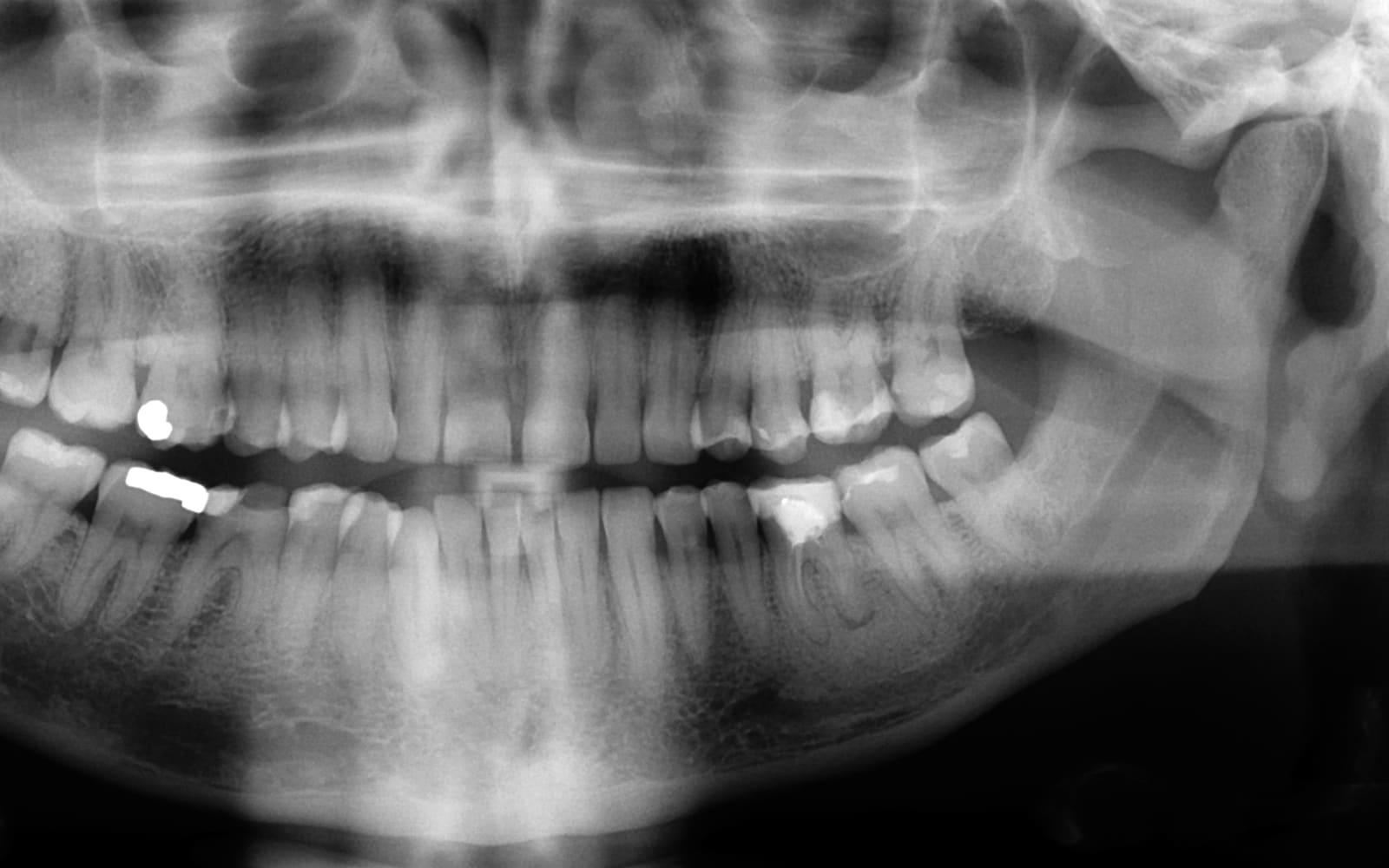
Imaging does the rest. A panoramic radiograph (OPG) shows all four third molars at once, their angulation, the depth of impaction, root shape, and — critically for the lower jaw — the relationship of the roots to the inferior alveolar nerve canal, which carries sensation to the lower lip and chin. Where that relationship looks close on a panoramic film, three-dimensional imaging is sometimes indicated before any decision about removal is made — that is arranged externally where a case calls for it, and it is one of the findings that can point toward a specialist referral rather than treatment in a general practice.
That nerve proximity is a genuine consideration with lower impactions. Temporary or, less often, lasting altered sensation in the lip or chin is a recognised risk of lower third molar surgery, and it is one of the specific things that should be discussed with you before any procedure — not discovered afterwards. It is also one of the clearest reasons certain cases belong with a specialist.
Does an impacted wisdom tooth always need to come out?
No. This is the most useful thing to know about the topic.
Asymptomatic, fully bony impactions that are causing no damage are, in many cases, reasonably monitored rather than removed — reviewed periodically with clinical examination and imaging to confirm nothing is changing. Removing a deeply buried tooth that is causing no problem carries its own risks, and those risks have to be weighed against the risk of leaving it.
Removal is more clearly indicated when there is:
- Recurrent pericoronitis — repeated infection and inflammation of the gum flap over a partially erupted tooth, which tends to recur once the pattern is established.
- Decay in the wisdom tooth itself, which is often impossible to clean adequately and difficult to restore given its position.
- Decay or root resorption in the second molar — a mesioangular or horizontal impaction pressing against the tooth in front can damage a healthy, functional molar that is far more valuable than the wisdom tooth.
- Cyst formation around the crown of an unerupted tooth, seen on imaging.
- Persistent, localised symptoms that examination traces clearly to that tooth.
- Periodontal pocketing behind the second molar that cannot be maintained while the impacted tooth remains.
None of these is decided from symptoms alone. It is a clinical judgement made after examination and imaging together, and a reasonable dentist will explain which of these factors applies in your case rather than treating removal as a foregone conclusion.
If a wisdom tooth is flaring up right now
Pericoronitis is usually what brings someone in urgently: a swollen, tender gum flap over a partially erupted lower wisdom tooth, a bad taste, sometimes difficulty opening the mouth or swallowing comfortably. That acute episode is managed first — cleaning and irrigation under the flap, and where clinically indicated, medication — and the decision about the tooth itself is made once the inflammation has settled and the picture is clearer.
Swelling that is spreading, fever, or difficulty breathing or swallowing is a reason to seek care without delay rather than waiting for a convenient appointment.
Dr Megha Kaul is one of the most respected dentists in Gurgaon, and if you have been told you have an impacted wisdom tooth and want a straight assessment of whether it actually needs removing — and by whom — that is a conversation worth having at N Square Dental Care Clinic before committing to anything.
Frequently asked questions
Do I need to remove an impacted wisdom tooth if it does not hurt? Not necessarily. Asymptomatic impactions causing no damage to the adjacent tooth and showing no cyst formation are often monitored with periodic examination and imaging instead. The decision rests on what the examination and radiographs show, not on the presence of pain alone.
What is a horizontal impaction? A wisdom tooth lying on its side, with its crown pointing into the second molar rather than upward into the mouth. It is one of the more complex patterns, because the crown often presses directly against the roots or rear surface of the healthy molar in front.
Is impacted wisdom tooth removal surgery? It depends entirely on the type. A soft-tissue impaction may be a straightforward extraction. A deep bony or horizontal impaction requiring bone removal or sectioning of the tooth is a surgical procedure and falls within oral and maxillofacial surgery — those cases are referred to a specialist rather than carried out at this clinic.
At what age do wisdom teeth come in? Typically between about 17 and 25, though roots often finish forming a little later. Some people never develop third molars at all, and some develop fewer than four.
Can an impacted wisdom tooth damage the tooth next to it? Yes. A forward-tilted or horizontal impaction can cause decay or root resorption in the second molar, and can create a periodontal pocket behind it that is very difficult to keep clean. This is one of the more common genuine reasons removal is advised.
What happens at the first appointment for an impacted wisdom tooth? An examination of the area and the adjacent molar, followed by imaging — usually a panoramic radiograph — to establish the angulation, depth, and the relationship of the roots to the nerve canal. From that, you get a clear answer on whether removal is indicated, and whether it is a case for a general dentist or for a specialist referral.
Where to find N Square Dental Care Clinic
Address: Shop No. 42, First Floor, Plaza, EMAAR Emerald Estate, Sector 65, Gurugram, Haryana 122101.
The clinic sits inside the EMAAR Emerald Estate plaza, on the Sector 65 stretch of Golf Course Extension Road (SPR) — one of Gurgaon’s main north-south corridors. Below are general routes from a few well-known parts of the city. Road conditions and one-ways in Gurgaon change often, so treat this as a starting orientation and confirm the live route on Google Maps or a similar app before driving — search “EMAAR Emerald Estate, Sector 65, Gurugram” or the clinic’s Google Business listing.
- From DLF Cyber City / Golf Course Road area: Head south on Golf Course Road, then continue onto Golf Course Extension Road (SPR) as it runs through Sectors 56-61 toward Sector 65. EMAAR Emerald Estate is on this same road.
- From NH-8 / IFFCO Chowk / Delhi border: From NH-8, come via Sohna Road, then turn onto Golf Course Extension Road (SPR) toward Sector 65 — the clinic is inside the EMAAR Emerald Estate plaza on this stretch.
- From Sohna Road: Golf Course Extension Road (SPR) connects directly off Sohna Road; follow it toward Sector 65/Sector 61 to reach EMAAR Emerald Estate.
- From the Gurgaon-Faridabad Road / Faridabad side: Golf Course Extension Road connects through to the Gurgaon-Faridabad corridor, giving a direct approach into Sector 65 from the south-east.
- By metro: The nearest metro connectivity is around the Rapid Metro stations near Sector 55-56, from where it’s a short drive along Golf Course Extension Road to Sector 65.
About the author: Dr Megha Kaul has practiced dentistry since 2008 and is the Owner, Founder & Dentist-in-Charge of N Square Dental Care Clinic, Sector 65, Gurugram.
Ready to book a consultation?